

How to Buy Decaf Coffee Beans Roasted to Order
Quick Summary
Buy decaf coffee beans from a specialty roaster or direct-to-consumer subscription company that prints a roast date on the bag. These sellers typically ship within 1 to 5 days of roasting, while national grocery brands often sit for weeks or months. Compare price per pound, not bag price.
- Confirm a printed roast date, since a best-by date only estimates shelf life.
- Ask how many business days pass between roasting and shipping.
- Calculate price per pound: bag price divided by ounces, times 16.
- Include shipping and any minimum order or subscription terms in your comparison.
- Store whole beans airtight, away from heat, light, and moisture, and grind before brewing.
Table of Contents
- Why Roasted-to-Order Decaf Tastes Better
- Where to Buy Decaf Coffee Beans Online
- How to Verify Beans Are Actually Roasted to Order
- Swiss Water Decaf Versus Other Decaffeination Methods
- Caffeine Left in Decaf and How Flavor Holds Up
- Choosing a Decaf Coffee Subscription That Fits Your Usage
- Getting Your First Roasted-to-Order Decaf Bag
- Frequently Asked Questions
Why Roasted-to-Order Decaf Tastes Better
Last Updated: October 30, 2026
Decaf coffee beans roasted to order taste noticeably better than beans that have sat on a shelf for months. Coffee begins losing its aromatic compounds soon after roasting, and the decline is faster once the beans are ground. Buying decaf coffee beans from a roaster who roasts after you order gives you the freshest possible cup.
The decaffeination process itself removes some flavor, so freshness matters even more for decaf than for regular coffee (Distinguishing between Decaffeinated and Regular Coffee by HS-SPME-GC×GC-TOFMS...). Stale decaf often tastes flat or papery. Beans roasted close to your delivery date keep more of their sweetness, body, and acidity.
Where to Buy Decaf Coffee Beans Online
Most people searching for decaf coffee beans online will find three types of sellers: national grocery brands, specialty roasters, and direct-to-consumer subscription companies. The differences that matter are not the marketing copy, they are roast date transparency, price per pound, bag size, and how fast the beans ship after roasting.
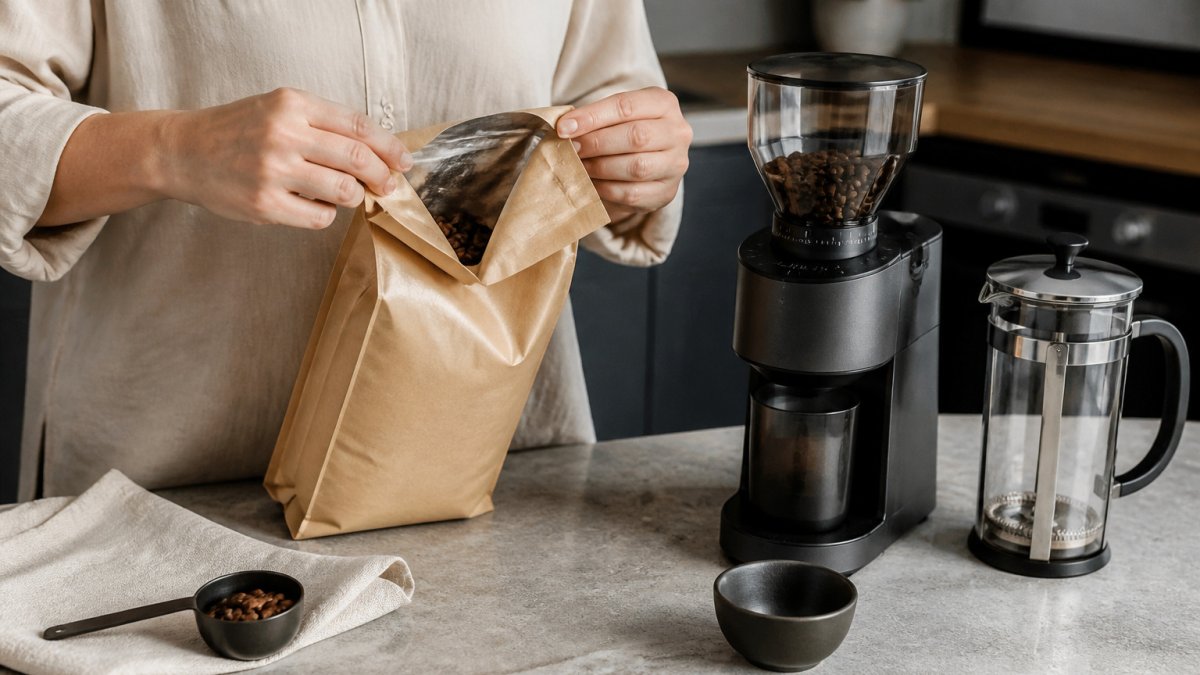
Here is how the three seller types typically compare on the factors that affect freshness and value:
| Seller type | Typical roast-to-ship window | Roast date on bag | Typical bag size | What to check |
|---|---|---|---|---|
| National grocery brand | Weeks to months | Often a "best by" date only | 12 oz | Whether a roast date exists at all |
| Specialty roaster | 1-5 days | Usually printed | 12 oz or 1 lb | Dispatch timing and shipping cost |
| Direct-to-consumer subscription | 1-3 days | Usually printed | 12 oz, 1 lb, or 2 lb | Minimum order and pause/cancel terms |
Those windows are common patterns, not guarantees, always confirm on the product page or by asking the seller directly.
Normalize price per pound before you compare. A $14 bag at 12 oz works out to about $18.67 per pound; a $22 bag at 1 lb is $22 per pound. The smaller bag can look cheaper at checkout while costing more per ounce. Do the math on every listing:
- Price per pound = (bag price ÷ bag ounces) × 16
- Add shipping unless the seller advertises free shipping above a stated threshold
- Factor in any minimum order or subscription commitment
If you want a concrete origin to start with, our Peru Decaf is a medium roast with caramel, smooth, and citrus notes. It is a single-origin coffee grown in Piura and Amazonas, Peru, and decaffeinated using the Swiss Water Process. It sells for $24.99.

For a darker, espresso-style option, the Decaf Espresso is a water-process decaf roasted dark. It is a blend, and its origin varies with availability. It also sells for $24.99.

When comparing sellers, look at the price per pound, the bag size, and whether shipping is included. A slightly higher price can be worth it if the beans arrive fresher, a bag roasted three days ago and a bag roasted three months ago can carry the same sticker price and deliver very different cups.
How to Verify Beans Are Actually Roasted to Order
"Roasted to order" is a phrase many sellers use loosely. A seller who truly roasts to order should be able to answer a few simple questions:
- What is the roast date printed on the bag?
- How many days pass between roasting and shipping?
- Does the product page list a specific roast date or a general month?
A roast date printed on the bag is the strongest signal. If a seller only says "fresh" without a date, ask for one before you buy.
Read the label carefully. A roast date is a specific calendar date tied to when the beans were roasted. A "best by" or "use by" date is a shelf-life estimate and tells you nothing about roast timing. Some sellers print a lot code or a packed-on date instead, ask what it refers to before assuming it is a roast date.
Check the dispatch window, not just the roast date. A bag labeled with a roast date can still have sat in a warehouse for weeks. Ask how many business days pass between roasting and the package leaving the facility. A common pattern among roasters who genuinely roast to order is dispatch within one to three business days of roasting; longer gaps suggest beans are roasted in batches and held.
Ask these questions before ordering:
- Is the roast date printed on the bag, and is it the roast date or a best-by date?
- How many business days between roast and ship?
- Is the coffee roasted after my order is placed, or pulled from existing stock?
- What shipping service is used, and what is the typical transit time?
- If the beans arrive and the roast date is older than expected, what is the return policy?
Verify after delivery. When the bag arrives, check the printed date against your order date. If the gap is longer than the seller promised, that is useful information for future orders, and grounds for a return under many sellers' policies.
Swiss Water Decaf Versus Other Decaffeination Methods
Decaffeination removes caffeine before roasting, and the method affects flavor. Swiss Water Process uses water and green coffee extract to remove caffeine without chemical solvents. Many buyers prefer it because the coffee keeps more of its original character.
Other methods use solvents such as ethyl acetate or carbon dioxide. Solvent-based decaf can be cleaner in flavor for some roasters, but the difference depends on the roaster and the bean. Our Peru Decaf is decaffeinated using the Swiss Water Process, so you can taste that method directly.
Caffeine Left in Decaf and How Flavor Holds Up
Decaf is not caffeine-free. Most decaf coffee retains a small amount of caffeine (the FDA). If you are sensitive to caffeine, check the seller's listing for caffeine information or ask directly.
Flavor holds up best when beans are stored well. Keep whole beans in an airtight container away from heat, light, and moisture. Grind just before brewing for the best cup.
Choosing a Decaf Coffee Subscription That Fits Your Usage
A decaf coffee subscription works well if you drink coffee steadily. If your intake changes from week to week, look for a plan that lets you adjust the delivery frequency or pause shipments.
Getting Your First Roasted-to-Order Decaf Bag
Start with one bag to see how the beans taste. The Decaf Espresso suits anyone who wants a bold, dark-roasted cup, while the Peru Decaf suits anyone who prefers caramel and citrus notes.
Once your beans arrive, store them properly to keep them fresh. Our guide, How to Keep Coffee Beans Fresh Longer: 2026 Guide, covers the basics. Grind just before brewing, and enjoy the cup while the flavor is at its peak.
Frequently Asked Questions
Are decaffeinated coffee beans available?
Yes. Decaf whole beans are sold by many roasters and online shops in a range of roasts and origins. Look for the words decaf or decaffeinated on the bag or product page, and check the statement of identity, which should read decaffeinated coffee. Goodest sells Peru Decaf, a medium roast single origin at $24.99, and Decaf Espresso, a dark roast blend at $24.99, so you can choose between a brighter cup and a bolder one for espresso.
How can I tell whether decaf coffee beans are freshly roasted?
Check for a roast date printed on the bag, not just a best-by date. Roasters that roast to order usually ship within days of roasting, so a recent roast date is the strongest signal. If a product page only lists a best-by date or no date at all, ask the seller for the roast date before you buy. Storing the beans in an airtight container away from heat and light after delivery helps them keep their flavor.
Does decaf coffee taste different when it is roasted to order?
Freshness affects decaf as much as regular coffee. Beans lose aroma and flavor after roasting, and decaf can taste flat if it sat on a shelf for months. Beans roasted close to the time you order them give you the flavor notes listed on the product page. The decaffeination method also shapes the flavor, so compare the process along with the roast date.
Can I buy decaf coffee beans through a subscription?
Yes. A decaf coffee subscription sends whole beans on a schedule you choose, so you do not need to reorder each time. When you compare subscriptions, check whether you can change the frequency, skip a delivery, or pause the plan, and whether beans are roasted close to shipping.
