

How to Choose Coffee Grind Size for Every Brew Method
Table of Contents
- Why Coffee Grind Size Decides How Your Cup Tastes
- How Grind Size Affects Coffee Flavor
- The Coffee Grind Size Chart: Coarse, Medium, and Fine
- The Best Grind Size for Espresso and Dialing In
- How to Adjust Coffee Grinder Settings Step by Step
- Troubleshooting by Taste and Brew Behavior
- How Roast, Freshness, and Grind Consistency Change Your Choice
- Frequently Asked Questions
Last Updated: October 12, 2026
Why Coffee Grind Size Decides How Your Cup Tastes
Coffee grind size is the biggest variable you control after the beans. Get it wrong, and great beans turn sour or bitter; get it right, and they taste sweet, balanced, and clear.
At Goodest coffee company, subscribers constantly ask why the same bag tastes different on different days. Usually, it's the grind.
Water pulls flavor out of coffee grounds. Smaller particles expose more surface area, so water extracts faster; bigger particles expose less, so extraction slows down.
Surface Area, Water Flow, and Extraction Speed
It's like sugar in tea: fine sugar vanishes in seconds, coarse sugar takes longer.
Coffee works the same way:
- Fine grind = more surface area = faster extraction
- Coarse grind = less surface area = slower extraction
- Water flow changes too, since tight-packed fine grounds resist water more than loose coarse ones
Resistance matters most in espresso, where water is pushed through under pressure. In a French press, water just sits there, so time does the work.
The Specialty Coffee Association's brewing guidance treats grind size and contact time as the two levers you adjust together. Change one, and you usually need to nudge the other.
How Grind Size Affects Coffee Flavor
Grind size controls how much flavor ends up in your cup, and which flavors show up first. Too fine for your brewer tastes bitter; too coarse tastes sour.
Coffee extracts in a rough order: acids and fruit first, then sweetness and body, then bitter compounds. Stop early and you get only the bright stuff; run long and bitterness takes over.
Reading Under-Extraction and Over-Extraction
Under-extraction means water didn't pull enough from the grounds: sour, thin, salty, hollow.
Over-extraction means water pulled too much: bitter, dry, harsh, sometimes chalky.
| Taste Signal | Likely Cause | Grind Fix |
|---|---|---|
| Sour, thin, salty | Under-extracted | Grind finer |
| Bitter, dry, harsh | Over-extracted | Grind coarser |
| Sour and bitter together | Uneven particles | Improve grind consistency |
| Weak but bitter | Too coarse plus too hot | Grind finer, drop temp |
Most people blame the beans. Most of the time, it's the grind.
The Coffee Grind Size Chart: Coarse, Medium, and Fine
A coffee grind size chart maps particle size to brewing method: coarse looks like sea salt, medium like table salt, fine like powdered sugar.
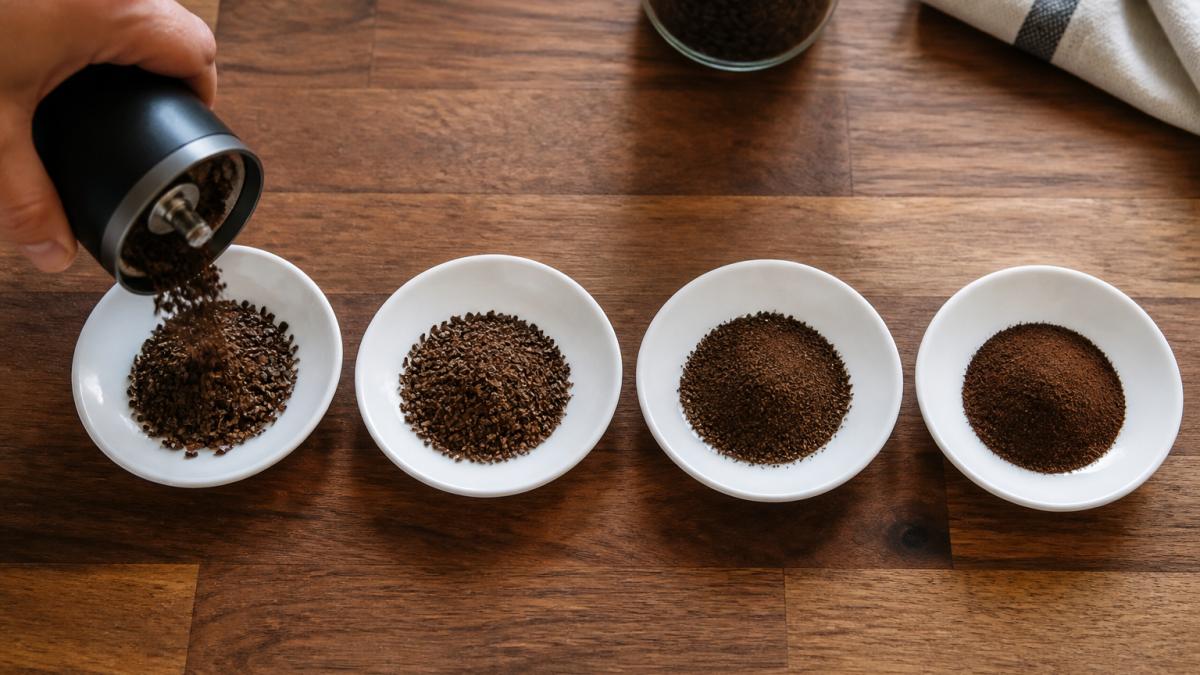
Here's the practical breakdown:
- Extra-coarse: chunky, like peppercorns. Cold brew and steeped immersion.
- Coarse: sea salt texture. French press.
- Medium-coarse: rough sand. Drip machines and some pour-over setups.
- Medium: table salt. Flat-bottom pour-over, like a Kalita.
- Medium-fine: fine sand. Cone pour-over, like a V60.
- Fine: powdered sugar. Espresso.
Matching Grind to Your Brewing Method
The rule: the longer water touches the grounds, the coarser you grind.

| Brew Method | Grind Size | Typical Brew Time |
|---|---|---|
| Cold brew | Extra-coarse | 12-18 hours |
| French press | Coarse | 4 minutes |
| Drip machine | Medium-coarse | 5-6 minutes |
| Flat-bottom pour-over | Medium | 3-4 minutes |
| Cone pour-over (V60) | Medium-fine | 2-3 minutes |
| Espresso | Fine | 25-30 seconds |
| Moka pot | Fine | 3-5 minutes |
Screenshot this chart.
The Best Grind Size for Espresso and Dialing In
Espresso is unforgiving: a tiny grind change swings the shot wildly.
You're balancing four things at once:
- Dose: how much coffee goes in, usually 18-20 grams
- Yield: how much liquid comes out, often 36-40 grams
- Shot time: how long the pull takes, ideally 25-30 seconds
- Grind: your main adjustment tool
An 18-second shot is under-extracted: grind finer. A shot that chokes past 40 seconds: grind coarser.
A common mistake is changing the dose to fix a bad shot. Change the grind first.
For espresso at home, we like our African Espresso, a medium-dark blend of Kenyan, Tanzanian, and Ethiopian beans.

How to Adjust Coffee Grinder Settings Step by Step
Most grind advice is written for espresso, but the same logic works for every brewer. Here's a repeatable workflow plus method-specific cues.
Total Time: 20-30 minutes per method Difficulty: Beginner
What You'll Need:
- A burr grinder (blade grinders chop unevenly and can't be dialed in)
- Your usual coffee and brewer
- A scale that reads to 0.1 g
- A timer
- A notebook or phone note for logging settings
The Universal Loop: One Variable at a Time
Every method follows the same five-step loop; only what you measure changes.
- Lock your recipe. Fix dose, water weight, water temperature, and brew time. Write them down. If two variables move at once, you learn nothing.
- Pick a starting grind. Use the chart in the previous section as your baseline for the brewer.
- Brew and record. Note the grind setting, total brew time, and how the water moved through the bed.
- Taste and diagnose. Sour and thin points to under-extraction; bitter and dry points to over-extraction. Use the taste table above.
- Move one or two clicks. Finer if under-extracted, coarser if over-extracted. Re-brew. Repeat until the cup tastes sweet and clear.
Expect three to five brews to land on a setting for a new bag. Big jumps waste beans and reset your reference point.
Method-Specific Cues
The taste signal is the same everywhere. The physical cue is not.
- Espresso: Target a 1:2 ratio (for example, 18 g in, 36 g out) in 25-30 seconds. Fast shot, sour taste: grind finer. Choked shot past 40 seconds: grind coarser. Change grind before you change dose.
- Pour-over (cone or flat-bottom): Watch the drawdown. A cone that finishes in 90 seconds is too coarse; one that stalls past 5 minutes is too fine. Aim for the brew time listed for your brewer in the chart above.
- Immersion (French press, cold brew): There is no flow to read, so taste is your only signal. For French press, the plunge resistance is a secondary cue: almost no resistance means grind finer, a fight means grind coarser. For cold brew, adjust in larger steps because a 12-18 hour steep amplifies small changes.
- Drip machine: These brewers run on a fixed cycle, so you have less control over time. If the basket overflows or the bed channels, grind coarser. If the cup is weak and sour, grind finer. Expect smaller usable range than a manual pour-over.
Why You Should Log Every Change
Grinder numbers aren't portable between machines, and they drift on the same machine as burrs wear in. Logging the setting, bean, roast date, and taste note gives you a personal reference no chart can replace.
Calibrating Your Grinder and Reading Its Numbers
Grinder numbers aren't universal: a "12" on one burr grinder means something different on another. Copying a friend's setting is a common mistake, their grinder has different burrs, wear, and calibration.
If your grinder drifts over time, recalibrate it against its zero point. Most burr grinders have a true zero where the burrs just touch. Find that point, then count clicks from there.
Troubleshooting by Taste and Brew Behavior
Taste tells you what to fix faster than any gadget. Learn the signals and you can diagnose any cup in seconds.
- Sour and thin: grind finer, or brew longer
- Bitter and dry: grind coarser, or brew shorter
- Weak but sour: grind finer and check your ratio
- Strong but flat: grind coarser and check water temperature
- Slow drawdown in pour-over: grind coarser
- Fast drawdown and watery cup: grind finer
Brew behavior matters too. A pour-over that drains in 90 seconds is too coarse; one that stalls past five minutes is too fine. For a French press, the tell is the plunge: almost no resistance means grind finer, a fight means grind coarser.
How Roast, Freshness, and Grind Consistency Change Your Choice
Roast level, freshness, and particle distribution all shift your grind setting. Treat them as three separate adjustments.
Roast Level
Light roasts are denser and resist water more, so they usually want a finer grind to hit the same extraction. Dark roasts are more porous and extract faster, so they often want a coarser setting. If you switch from a dark roast to a light roast on the same brewer and the cup suddenly tastes sour, the roast is a likely culprit before the grinder is.
Freshness
Beans in their first week after roasting release carbon dioxide, which pushes water away and slows extraction. Grind slightly coarser during that window. After a week or two, the gas settles and you can tighten up. Our 6 Bean Blend is a dark roast house blend that works well across espresso and drip, but the right setting changes as the bag ages.

Grind Consistency and Particle Distribution
Grind size is not one number. Every batch of grounds is a distribution: a target particle size surrounded by smaller fines and larger boulders.
Why the spread matters: fines over-extract and turn bitter, boulders under-extract and taste sour.
You can read your distribution without lab gear. Spread a scoop of grounds on a white plate in a thin layer and look closely under good light.
- Even color and texture across the pile: tight distribution, good for most brewers.
- Visible dust plus distinct chunks: wide distribution. Expect muddy, inconsistent cups.
- Mostly uniform with a few fines: normal for most burr grinders, and usually fine for immersion and drip.
- Heavy fines: common on espresso-focused grinders and can slow pour-over drawdown even when the average size looks right.
When to Change the Grinder Instead of the Setting
If you have moved the dial across its useful range and still get sour-and-bitter cups at the same time, the distribution is the bottleneck.
For cold brew fans, coarse is non-negotiable. Our Cold Brew Coffee is ground very coarse on purpose, since a 12-hour steep would turn fine grounds into a bitter, muddy mess. Even there, a tighter distribution means a cleaner cup.
Frequently Asked Questions
What is the best grind size for coffee?
There is no single best coffee grind size, because the right setting depends on your brewing method. French press and cold brew need a coarse grind, drip and pour-over sit in the medium range, and espresso requires a fine grind. Start with the chart above for your method, then adjust one notch finer or coarser based on taste. If the cup tastes sour and thin, go finer; if it tastes bitter and harsh, go coarser.
How do I know if my coffee grind is too fine or too coarse?
Taste and brew time tell you. A grind that is too fine slows water flow, so a pour-over drawdown drags past four minutes and the cup turns bitter and dry. A grind that is too coarse lets water rush through, finishing well under two minutes with a sour, watery result. In espresso, a too-fine grind chokes the machine and stretches shot time past 35 seconds, while a too-coarse grind gushes out in under 20.
Should I buy pre-ground coffee or grind whole beans at home?
Whole beans give you control over coffee grind size, and that control is the single biggest flavor variable you own. Pre-ground coffee locks you into one particle size, so it suits only one brewing method and goes stale faster once opened. If you brew several ways, such as espresso on weekdays and French press on weekends, a burr grinder pays for itself. If you only ever use one method, pre-ground can still work.
How do roast level and bean freshness affect my grind setting?
Both shift the setting you need. Light roasts are denser and often need a finer grind to extract fully, while dark roasts are more porous and can turn bitter at the same setting, so go slightly coarser. Fresh beans release carbon dioxide, which slows water flow, so a bag roasted days ago may need a coarser grind than the same coffee three weeks later. Recheck your setting with each new bag.