

How Do Coffee Roast Profiles Work? A Practical Guide
Last Updated: November 2, 2026
Quick Summary
Coffee roast profiles are the planned record of how a roaster applies heat over time, measured by bean temperature and tracked from charge to drop. They work by combining five key points: charge temperature, bean temperature, rate of rise, first crack, and drop temperature. Getting those points right gives you repeatability; getting them wrong produces baked, scorched, or flat coffee.
- Charge temperature is the drum heat at the moment beans enter and sets the tone for the whole roast.
- Rate of rise is how many degrees the bean temperature climbs per minute.
- First crack signals the start of development, and most specialty roasts drop between first and second crack.
- Short, hot roasts tend to keep bright acidity and delicate aromatics.
- Change one variable at a time and log every batch to make coffee roast profiling repeatable.
Table of Contents
- What a Coffee Roast Profile Actually Is
- Reading a Coffee Roast Profile Chart Step by Step
- The Coffee Roasting Stages From Drying to Development
- How Roast Time Affects Coffee Flavor
- Coffee Roast Levels and Flavor: Light, Medium, and Dark
- Troubleshooting Common Roast Defects
- Adapting a Profile to Different Beans and Equipment
- Choosing Beans That Match the Profile You Want
- Frequently Asked Questions
What a Coffee Roast Profile Actually Is
Coffee roast profiles are the planned record of how a roaster applies heat over time, measured by bean temperature and tracked from charge to drop. It is the recipe behind every batch. Change the time, heat, or airflow, and you change the flavor in the cup.
A roast profile is best treated as a set of decisions, not a fixed script. Two roasters can hit the same final color and still produce very different coffee. Why? Because the path matters as much as the endpoint.
Here is the short version of how coffee roast profiles work:
- Charge temperature sets the starting heat in the drum
- Bean temperature tracks what the coffee itself is doing
- Rate of rise shows how fast the beans are heating
- First crack marks the start of real flavor development
- Drop temperature decides where you stop the roast
Get those five points right and you have repeatability. Get them wrong and you get baked, scorched, or flat coffee. Below, we'll show you exactly how to read each one.
Reading a Coffee Roast Profile Chart Step by Step
A roast curve chart plots bean temperature on the vertical axis and roast time on the horizontal axis.
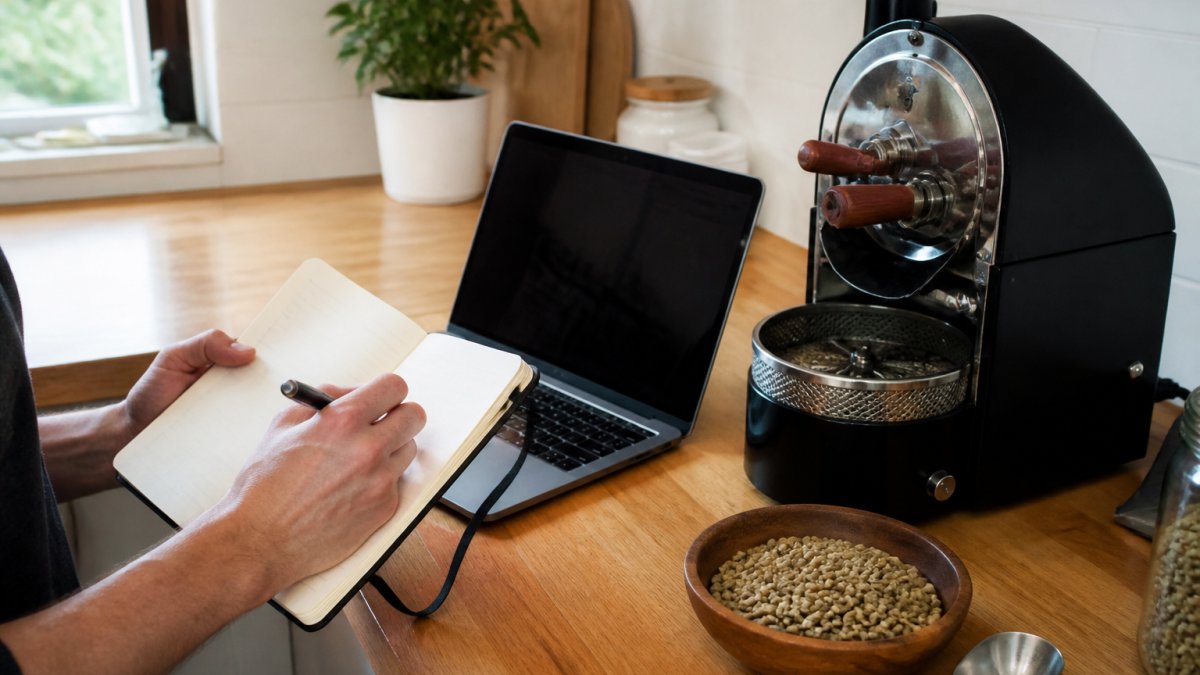
Step 1: Find the charge. The line starts low. That is your charge temperature, the heat of the drum when the green coffee goes in.
Step 2: Locate the turning point. Bean temperature drops after charge, bottoms out, then climbs again. That low spot is the turning point.
Step 3: Follow the climb. The rising line is your rate of rise. A steep line means fast heating.
Step 4: Mark first crack. Most logging software lets you flag it. Note the time and temperature.
Step 5: Read the drop. Where the line ends is your drop temperature and total roast time.
Step 6: Compare to your plan. Overlay the curve on your last batch. Differences here are your adjustments for next time.
One habit separates roasters who improve from roasters who guess: log every batch. Same bean, same weight, same charge. Then change one variable at a time.
The Turning Point and Charge Temperature
Charge temperature is the drum heat at the moment beans enter. It sets the tone for the whole roast. Charge too hot and the bean surface scorches before the inside develops. Charge too cool and the roast drags, flattening acidity and muting sweetness.
The turning point is the lowest bean temperature after charge. A typical turning point lands somewhere in the first minute and a half to two minutes. Its position tells you how hard the initial heat hit. A very low turning point usually means an aggressive charge.
Rate of Rise and Its Measurement Limits
Rate of rise, often shortened to RoR, is how many degrees the bean temperature climbs per minute. It is the single most useful number on the chart, and also the most misunderstood.
Keep in mind that rate of rise is calculated from bean temperature readings, which can be noisy. Probe placement, batch size, and probe response time can all skew the number, so smooth the data before you react to it.
The Coffee Roasting Stages From Drying to Development
Every roast moves through three stages, and each one shapes a different part of the final cup. Understanding these coffee roasting stages is the difference between following a recipe and knowing why it works.
Drying phase. Moisture leaves the green coffee. The bean surface changes color from green to yellow. This stage sets up everything after it.
Maillard reaction. Sugars and amino acids react as the bean browns. This is where aroma compounds and much of the body form. Caramelization follows close behind, building sweetness.
Development phase. Starting around first crack, the bean expands and internal structure softens. Development time controls how much acidity survives and how much body builds.
First Crack and Second Crack
First crack is the audible pop of moisture and gas escaping as the bean structure breaks down. It signals the start of development. Second crack is a quieter, faster crackling that marks a much darker roast, where bean structure breaks down further and oils reach the surface.
Most specialty roasts drop between first and second crack. Going past second crack pushes toward dark roast territory, where origin character fades and roast flavor takes over.
How Roast Time Affects Coffee Flavor
Roast time controls how flavors develop, and the relationship is not linear. A fast roast preserves acidity and origin character but risks underdeveloped, grassy notes. A slow roast builds body and sweetness but can flatten brightness or produce baked flavors if it drags too long.
Here is how roast time affects coffee flavor in practice:
- Short, hot roasts tend to keep bright acidity and delicate aromatics
- Medium-length roasts balance sweetness and acidity
- Long, slow roasts build body and chocolate notes but risk dullness
- Stalled roasts taste flat and papery, no matter the final color
Time and temperature work together.
Coffee Roast Levels and Flavor: Light, Medium, and Dark
Roast level describes where you stopped, and coffee roast levels and flavor move together in predictable ways. Light roast keeps more origin character and acidity. Medium roast balances sweetness and body. Dark roast trades origin detail for roast-driven notes like dark chocolate and caramel.
| Roast Level | Typical Flavor | Acidity | Body | Good For |
|---|---|---|---|---|
| Light | Fruity, floral, tea-like | High | Light | Pour-over, filter |
| Medium | Balanced, sweet, nutty | Medium | Medium | Drip, French press |
| Medium-dark | Chocolate, caramel | Lower | Full | Espresso, milk drinks |
| Dark | Bold, smoky, bittersweet | Low | Heavy | Espresso, dark blends |
If you want to taste a sweeter profile, our Blonde blend is a sweet Central American and African mix that is great for sweet espresso ($24.99). For the darkest end, the Italian Roast is our darkest roast, a slow-roasted blend of specialty grade Arabica/Robusta ($24.99).

Troubleshooting Common Roast Defects
Roast defects usually trace back to one variable: heat application, airflow, or time. The useful skill is not memorizing a defect list but learning to read the defect in two places at once, the curve during the roast and the cup after it.
Scorching. Look for dark, charred patches on the flat sides of the bean, often with a bitter, ashy edge in the cup.
Tipping. The tips of the bean are burned while the rest looks normal. In the cup, tipping reads as a sharp, burnt note that sits on top of otherwise acceptable flavor.
Baked coffee. The cup is flat and papery, with muted acidity and a hollow mid-palate, even when the final color looks correct.
Underdevelopment. Grassy, sour, or peanut-like notes with a thin body. On the curve, underdevelopment shows up as a short development phase, dropping soon after first crack, or a drop temperature that leaves the bean structure tight.
Uneven roast. Mixed bean colors in the same batch, with some beans clearly darker than others.
A practical troubleshooting loop: cup every batch blind, note the dominant defect, match it to the curve signature above, change one variable, and roast again. Two or three iterations usually isolate the cause. If the defect persists across bean changes and batch sizes, suspect probe placement or airflow before you suspect the profile itself.
Adapting a Profile to Different Beans and Equipment
No single profile fits every bean. Density, moisture content, processing method, and origin all shift how a bean responds to heat. A washed coffee from high altitude usually handles heat differently than a natural-process bean.
Step 1: Read the bean before you roast it. Start with density and moisture.
Step 2: Set batch size against drum capacity. A batch that fills the drum too far reduces bean movement, creates uneven contact with hot metal, and shows up as mixed color and baked edges.
Step 3: Adjust for roaster type. Small drum roasters respond faster to gas changes and hold less heat, so reduce charge heat and expect quicker reactions. Larger drums carry more thermal mass, so changes lag and you should make smaller, earlier adjustments.
Step 4: Change one variable at a time. When you move to a new bean or a new batch size, hold charge temperature, airflow, and drop target constant and change only the variable you are testing.
If you want to practice on contrasting beans, our Ethiopia Natural is a medium-light single origin with milk chocolate, fruity, and caramel notes ($24.99). For a contrast, Bali Blue is a medium-dark single origin with dark chocolate and molasses notes ($24.99). Roast each on your reference profile first, cup both, then apply the decision sequence above to see how each bean asks for a different adjustment.


Choosing Beans That Match the Profile You Want
The best bean is the one that suits how you roast and how you brew. Match the bean to the profile, not the other way around.
A few practical filters:
- Want bright, fruity cups? Choose light-roasted single origins
- Want chocolate and body? Choose medium-dark or dark roasts
- Brewing espresso? Favor medium-dark to dark profiles
- Brewing pour-over? Favor light to medium profiles
Once you have the beans, freshness matters, and storage helps keep your roast profile work from being wasted.
Frequently Asked Questions
What is a coffee roast profile?
A coffee roast profile is the record of how heat and airflow are applied to green coffee over time, captured as bean temperature against the clock. It includes charge temperature, the turning point, rate of rise, first crack timing, and drop temperature. Two roasters can hit the same roast level with very different profiles, which is why the same green coffee can taste fruity and bright under one profile and flat under another.
How does roast time affect coffee flavor?
Roast time decides how far sugars caramelize and how much acidity survives. A fast, hot roast can leave bright acidity and pronounced fruit but risks uneven development and scorching. A slower roast builds body and sweetness but can flatten origin character if pushed too long.
What is the difference between a roast profile and a roast level?
Roast level describes the endpoint, such as light, medium, or dark, judged by color and bean surface. A roast profile is the entire path taken to reach that endpoint, including temperature curve, airflow, and timing. You can reach a medium roast level with a fast profile or a slow one, and the cup will taste different even though the beans look similar.
How can I tell whether a coffee roast profile is balanced?
A balanced profile usually shows a smooth declining rate of rise with no flick or crash near the end, first crack occurring at a predictable time, and development time long enough to avoid grassy or baked notes. On the cupping table, balance shows up as sweetness and acidity sitting together without one dominating. Logging each batch and tasting side by side is the only reliable way to confirm it.
Roasting well comes down to repeatability: same bean, same charge, one variable changed at a time. That is hard to do when your supply is inconsistent. Goodest coffee company ships freshly roasted single origins and blends on a subscription, so you can build a profile around beans you actually know. Choose your roast level, set your delivery schedule, and pause whenever you need to. Get started with Goodest coffee company and roast with beans that behave the same way every batch.
